What is the MSPSL (Mirror, Signal, Position, Speed, and Look) routine for driving?
MSPSL is an acronym for Mirror, Signal, Position, Speed, and Look. In the UK and in many other countries drivers adhere to this procedure in order to drive safely when going through junctions, roundabouts, crossroads and turns.
View this MSPSL guide as a driving checklist; the framework will enable you to make safe and informed decisions each time you come across a hazard or need to change direction.
We want these actions to become automatic; just as you don’t think about each step when you’re walking, MSPSL should as well become second nature while driving.
Why Does MSPSL Matter So Much on the Driving Test?
Here are the reasons why should you follow MSPSL routine:
- Safety is improved by MSPSL since it enhances your awareness of other vehicles, pedestrians, and cyclists. You systematically check your mirrors and blind spots. As a result, you are able to detect hazards before an accident occurs.
- It helps improve communication since you indicate and position your vehicle in such a way as to show other drivers what your intentions are. Giving clear signals eliminates confusion and helps keep the traffic flowing.
- To pass your driving test you have to show that you use MSPSL correctly, and you could fail the test if you omit any steps or use them in the wrong order.
- Make You confident: by taking a structured approach you can reduce your anxiety, since when you know precisely what to do at each stage you feel more in control and less stressed.
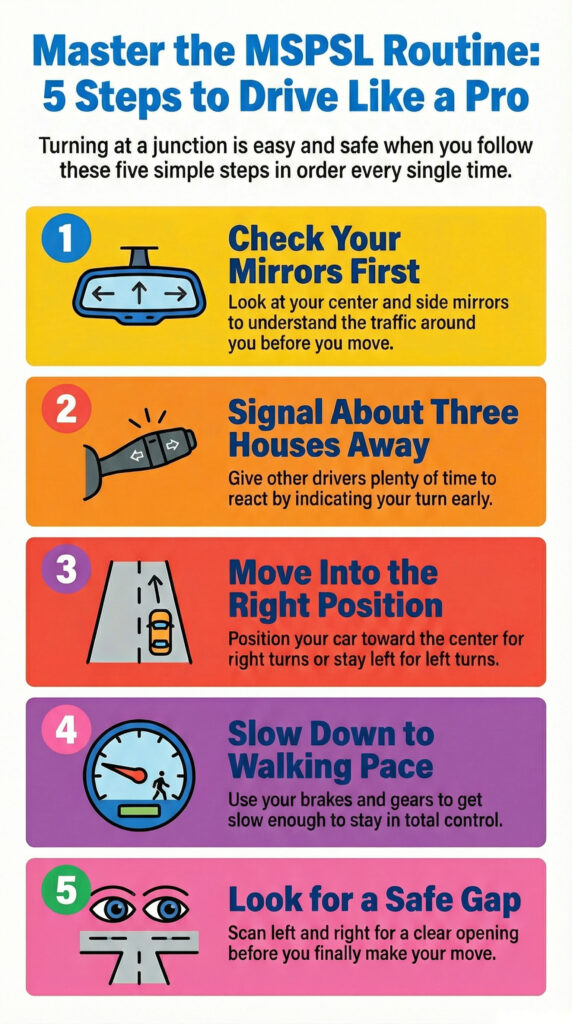
The Five Steps of MSPSL Explained?
Each component of the MSPSL routine has a specific purpose. Here is how to apply them correctly.
1. Mirror
What to do: Check your interior mirror first before you make any maneuver. Then check the appropriate door mirror based on your intended direction.
- Turning left? Check your interior mirror, then your left door mirror.
- Turning right? Check your interior mirror, then your right door mirror.
- Going straight? Still check both. You need to know what is around you.
Common mistake: Many learner drivers glance at mirrors without registering what they see. Do not just look. Take notice. Ask yourself: Is there a car close behind me? Is a cyclist approaching? Is someone about to overtake?
Memory tip: The 7-3-21 technique helps you remember MSPSL. Think: 7 keys to safe driving, 3 seconds following distance, 21 days to form a habit.
2. Signal
What to do: Use your indicator to tell other road users where you are going. Timing matters. Signal too early and you confuse people. Signal too late and they do not have time to react.
The 3 house rule: Signal approximately three houses before your turn. This is roughly 100 feet. This gives others enough notice without causing confusion about which turn you are taking.
When not to signal: Do not signal if it would mislead other drivers. For example, if there is a side road very close before your intended turn, wait until you pass the first junction. This is safer.
3. Position
What to do: Position your car based on your intended direction. Your position serves as a secondary signal to other drivers.
- Going straight or turning left: Stay in the center of your lane, or move slightly to the left.
- Turning right: Move toward the right side of your lane. Stay left of the center line.
- At roundabouts: Use the left lane for left and straight exits. Use the right lane for right turns.
Why positioning matters: Experienced drivers can predict your intentions based on where you position your vehicle. Proper positioning also gives you better sightlines and turning angles.
4. Speed
What to do: Reduce your speed to approximately walking pace as you approach the junction. This is typically 10 to 15 KPH. Shift into second gear to maintain smooth control.
Practice guideline: UK learner drivers should complete around 30 hours of professional driving lessons. Learning speed control can take some time and practise.
Why slow down: Reducing speed gives you more time to observe, react, and make safe decisions. Your vehicle becomes easier to control during the turn. Your stopping distance also reduces if something unexpected happens.
Common mistake: New drivers often approach junctions too quickly. This is one of the hardest habits to break. Practice smooth, gradual braking instead of sudden stops.
5. Look
What to do: Perform a final comprehensive check before you commit to your maneuver. Look left, look right, check blind spots, and scan for pedestrians, cyclists, and other vehicles.
The 12 second rule: Good drivers scan 12 seconds ahead of their current position. This means looking far down the road to anticipate hazards early. Do not just focus on what is immediately in front of you.
Hand position checkpoint: Place your hands at the 10 and 2 position on the steering wheel as you approach junctions. You can also use the 9 and 3 position. This gives you maximum control for turning.
When to Use the MSPSL Routine?
You will use MSPSL constantly while driving. It applies to many different situations. Here are the most common ones:
Junctions
You need to use full MSPSL at every T-junction, crossroad, or intersection. Follow all five steps whether you turn left, right, or go straight. This ensures you stay aware of traffic from all directions.
Roundabouts
Roundabouts can be intimidating. MSPSL makes them manageable. Apply the routine as you approach. Make sure you are in the correct lane, traveling at an appropriate speed, and checking for vehicles already on the roundabout.
Crossroads
Four-way intersections demand extra attention. Use MSPSL to prepare well in advance. Make sure you look in all directions before you proceed.
Right and Left Turns
Apply MSPSL any time you change direction. Even simple residential turns benefit from the routine. You never know when a cyclist or pedestrian might appear.
MSPSL Action Summary
| Stage | Physical Action | The ‘So What?’ (Primary Benefit) |
|---|---|---|
| Mirror | Check interior, then door mirror. | You spot hazards and make a safe judgement |
| Signal | Indicate 3 houses before the turn. | You show others what you’re about to do, so they can guess your next move and drive safer around you. |
| Position | Move left or just left of center. | You use it as a clear signal, and it also protects the space around your car. |
| Speed | Brake to 10–15 KPH; shift to 2nd gear. | You keep control of the car and give yourself extra time to react. |
| Look | Scan left, right, and ahead. | A final decision point to confirm “Can I go?” |
Common MSPSL Mistakes to Avoid
Even experienced drivers sometimes make these errors. Watch out for these pitfalls:
Neglecting Mirror Checks
You create danger when you fail to check mirrors or check them too quickly without processing the information. Always take a full second to observe what is around you.
Forgetting to Signal
Some drivers get lazy about signaling. They skip it when they think no one is around. Always signal. You never know when a pedestrian or cyclist might be approaching.
Inconsistent Speed Control
You create unpredictability when you approach junctions at wildly different speeds. Aim for smooth, consistent deceleration every time.
Lack of Situational Awareness
Going through the motions of MSPSL without truly paying attention defeats the purpose. Stay engaged and focused on your surroundings at all times.
Frequently Asked Questions
What does MSPSL stand for?
MSPSL stands for Mirror, Signal, Position, Speed, Look. It’s the five-step routine taught to all UK learner drivers and assessed during the DVSA practical driving test. Each step must happen in that order.
Is MSPSL tested in the UK driving test?
Yes. DVSA examiners watch for correct MSPSL application throughout the test. Junction observation is the single most common serious fault in 2024-25 test data. Skipping or reordering the steps can result in a serious or dangerous fault, either of which means an immediate fail.
What’s the difference between MSM and MSPSL?
MSM (Mirror, Signal, Manoeuvre) is the three-step sequence in the Highway Code (Rule 161). MSPSL breaks the “Manoeuvre” step into three parts sequence “Position, Speed, and Look“. This makes the sequence clearer for learners who are still building the habit.
When should I use the MSPSL routine?
MSPSL is used every time you change direction or approach a risky situation. That includes T-junctions, crossroads, roundabouts, left turns, right turns, and lane changes. It applies on quiet residential streets just as much as on busy main roads.
How early should I signal before a turn?
Signal roughly three houses before your turn, which is about 100 feet. The Highway Code says signals should be given “in good time.” If there’s a side road close before your intended turn, wait until you’ve passed it to avoid confusing other drivers.

OR CALL US AT
0752-780-7069
Latest Blog
September 21, 2026

September 10, 2026

May 27, 2026

May 9, 2026


March 16, 2026
Book your first driving lesson for only £35/hour (min 2 hr)
Book a lessonSee Our Reviews On



We offer friendly, value-for-money, driving lessons in Merton, Sutton and South West London to suit drivers of all abilities. We guarantee all pupils pass first time.
 Can I help you!